Reading tips
How to read a tarot spread, step by step
Read a tarot spread in a set order, one step at a time, and even a large layout stays manageable.
A tarot spread can look like a lot to take in: several cards, each in its own place, each with its own picture. Reading one gets easier when you take it in a set order. This is a four-step method that works for any tarot spread, from three cards to a Celtic Cross.
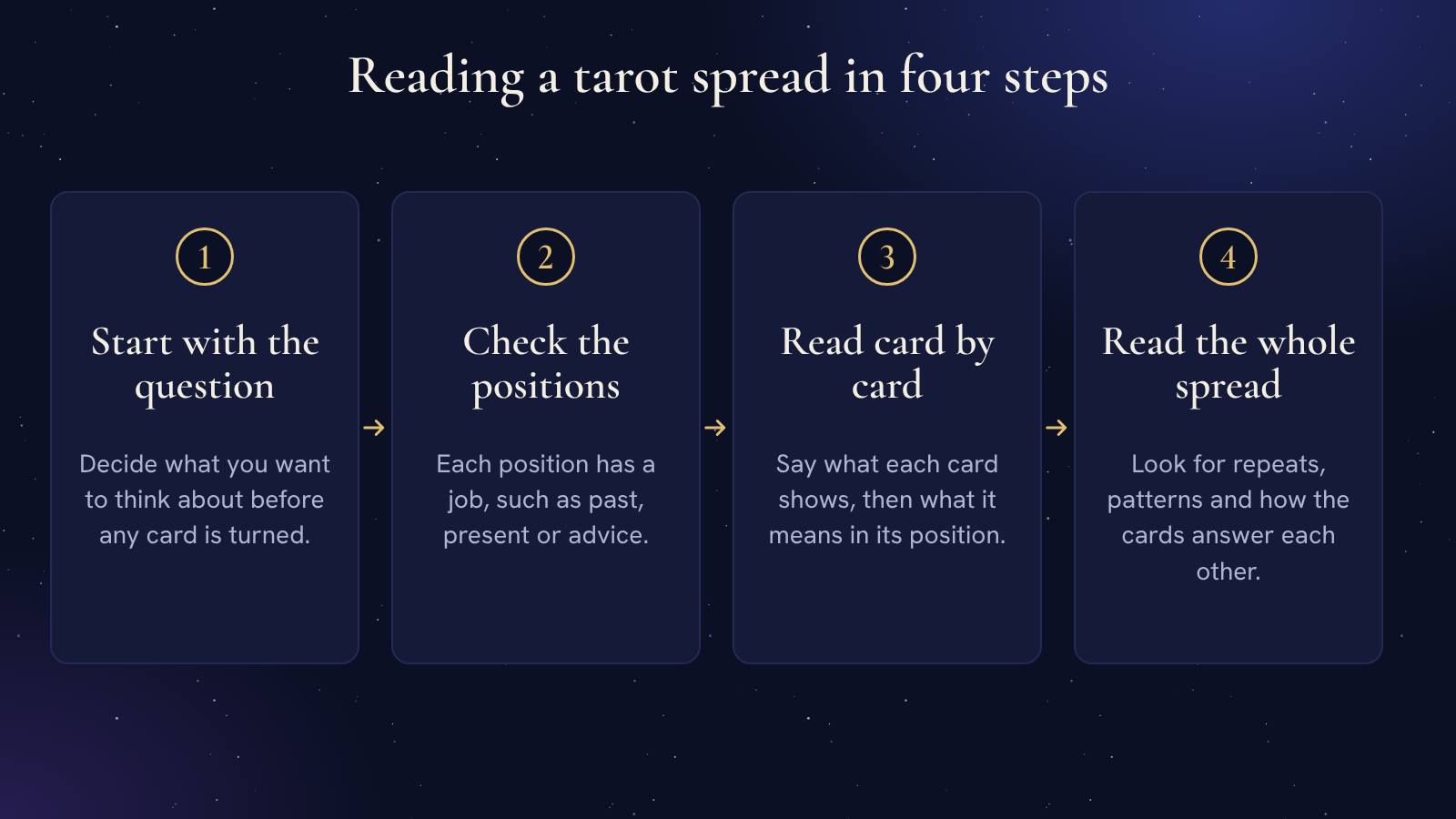
Step 1: start with the question
Before you turn a card, decide what you want to think about. A good question is open and about you, such as "What should I keep in mind about this move?" rather than "Will I get the job?" Tarot can't tell you what will happen. It can give you prompts to think about what matters to you.
If you do not have a question, you can read for a general theme instead, such as "What is on my mind this week?"
Step 2: check the positions
Look at the layout before you look at the pictures. Each position has a job. In a three-card spread, the positions might be past, present and next. In a Celtic Cross, one position covers the heart of the matter and another covers what is crossing it. If you are not sure what a position asks, read that first. The guide to tarot card positions explains how a position changes what a card says.
Step 3: read each card on its own
Take the cards one at a time, in the order of the positions. For each one:
- Describe what you see. Who or what is on the card, what are they doing, and what is the mood? This works even if you do not know the card's name.
- Name the card. Note whether it is a major or minor arcana card, and which suit it belongs to if it is a minor one.
- Tie it to the position. Ask what this card says in answer to this position's question.
- Check the direction. If you read reversed cards, note whether it came up upright or reversed.
Write a short phrase for each card. A single line is enough, because you will use these in the next step.
Step 4: read the whole spread together
Now step back. Read your short phrases in order, as if they were sentences in a paragraph. Then look for patterns:
- Repeats. Several cards from one suit suggest a theme. Four cups in a spread, for example, point toward feelings and relationships.
- Balance. Many major arcana cards suggest bigger themes, and many minor ones suggest everyday matters.
- Contrast. A hopeful card beside a cautious one often shows a tension in the question.
- Direction. Notice whether the story moves from one mood to another across the positions.
Finish by returning to your question and writing one or two sentences in answer. If the answer seems thin, that is fine. A reading is a starting point for thinking, not a verdict.
Common slips to avoid
Reading every card in isolation, so the result sounds like a list of definitions, is the most common one. Another is reading the cards to find the answer you hoped for. Settling the question and positions first guards against that. If a card seems to say something unwelcome, ask what part of the question it is pointing at rather than skipping it.
Tarot has no demonstrated ability to predict events. Readings are for entertainment and reflection only, and they aren't medical, legal or financial advice.
Where to go next
If you are new to tarot, start with the guide to what a tarot spread is. When you have a spread in front of you, you can photograph it and have it read card by card, with each card taken in its position.