Tarot spreads
The Celtic Cross tarot spread explained
The Celtic Cross is a ten-card tarot spread that looks at one situation from many sides. Here is how the cross and the staff fit together.
The Celtic Cross is probably the best-known tarot spread. It uses ten cards, takes a little longer to read than most layouts, and gives a detailed picture of one situation from several sides. Despite the name, it is not an ancient Celtic practice. It is a modern spread that became popular in English-language tarot through early twentieth-century writing, and decks and readers have adapted it ever since.
The shape of the spread
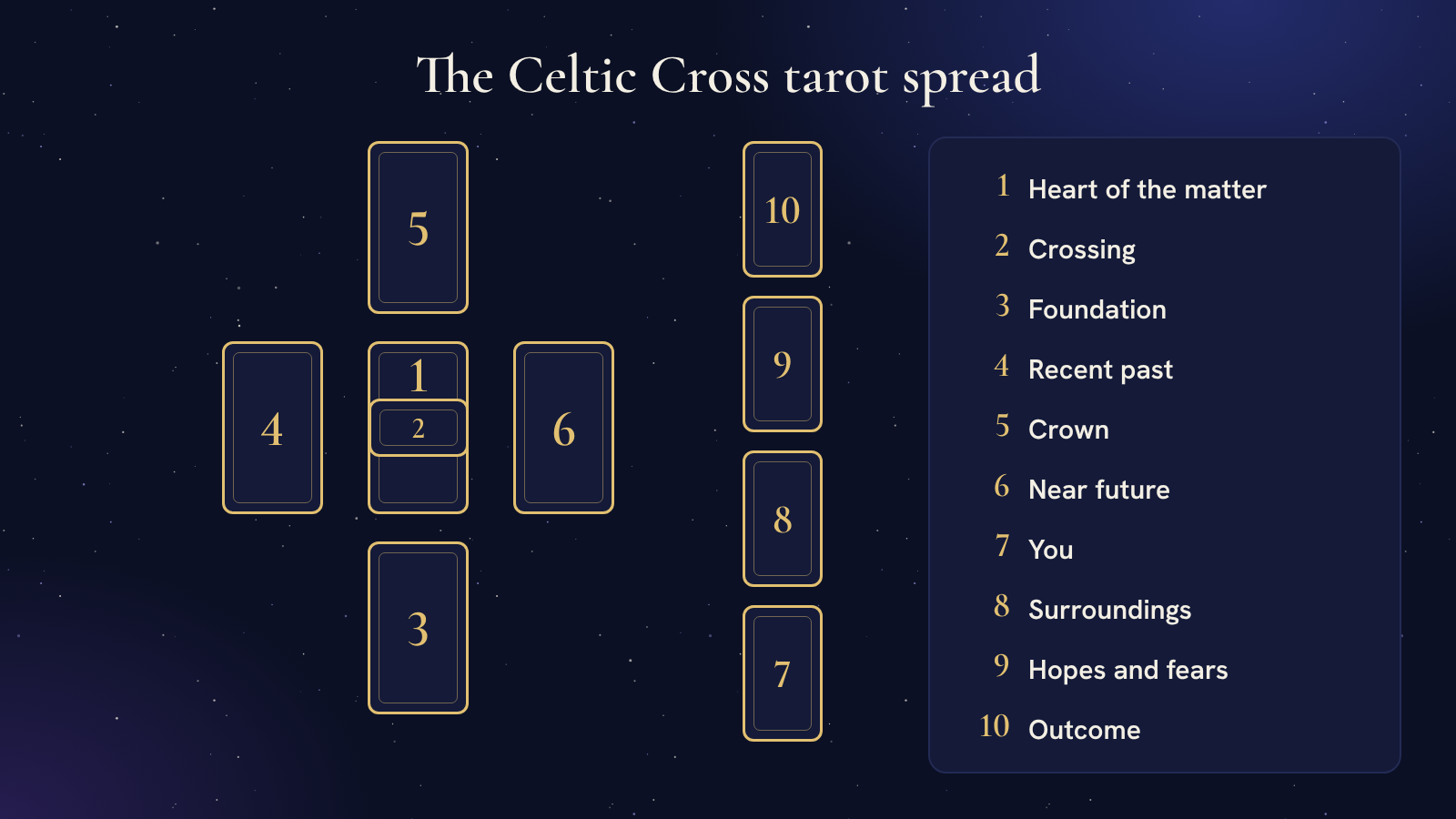
The layout has two parts. Six cards form a cross on the left. Four cards form a vertical staff on the right.
- The cross (cards 1 to 6): card 1 sits in the centre, card 2 is laid across it, card 3 sits below, card 4 to the left, card 5 above and card 6 to the right.
- The staff (cards 7 to 10): four cards in a column, with card 7 at the bottom and card 10 at the top.
What the two halves do
A helpful way to think about it: the cross describes the situation, and the staff describes you and what surrounds you. The cross covers the heart of the matter, what crosses it, its root, the recent past, the best aim and the near future. The staff looks at your own approach, outside influences, your hopes and fears, and where it may head.
Reading the cross first gives you the story. Reading the staff next shows how you are positioned within it.
The ten positions at a glance
- Heart of the matter
- Crossing (the challenge)
- Foundation (the root)
- Recent past
- Crown (goal or best aim)
- Near future
- You (your approach)
- Surroundings (outside influences)
- Hopes and fears
- Outcome (where it may head)
Each one gets a fuller treatment in Celtic Cross tarot spread positions, one by one. Keep in mind that readers vary in the order they lay the cards and in how they name some positions, so you may see slightly different versions in books and online.
When the Celtic Cross suits a question
This spread works best when you have a real situation with several moving parts: a decision, a change of direction, a tangled relationship or a project that feels stuck. It is less suited to a quick daily check-in, where one or three cards will do. Ten cards can produce a lot of detail, and a vague question tends to produce a vague reading.
A good question is specific but open: "What do I need to understand about changing careers?" rather than "Should I quit?" Having the question written down helps you stay on track when the cards start pulling in several directions.
Reading it without getting overwhelmed
- Go in order. Take one card at a time and note what you see before reaching for a meaning.
- Look for repeats. The same suit, number or card appearing more than once usually marks a theme worth attention.
- Pair cards. Cards 1 and 2 belong together, as do 3 and 5, and 4 and 6. Reading them as pairs shows tension or support.
- Finish with a summary. Write two or three sentences on the whole spread. If you can't, return to the card that confuses you.
Tarot has no demonstrated ability to predict events. Readings are for entertainment and reflection only, and they aren't medical, legal or financial advice.
Where to go next
If ten cards is more than you want, the horseshoe tarot spread offers seven. For the method behind any spread, see how to read a tarot spread, step by step. When your Celtic Cross is laid out, you can photograph it and have it read card by card.